
October 2026
Monthly Catchup
With daylight savings and warm day predicted, we'll meet outside this Friday October the 9th, 6pm in the garden next to Borderlands at 30a Pickett St, Footscray for a chat about how we can get some progress. All welcome. https://www.facebook.com/share/1K3xwpdgME/
State Election Campaign: Strategic Cycling Corridors
Sustainable transport is going to be an issue at the next State Election and we need your support.
Strategic Cycling Corridors (SCCs) are the state's plan for a network of safe bike routes across Melbourne and regional centres. But after decades of talk only a small fraction has been built. That's why BikeWest is partnering with Bicycle Network and other community groups across the state to ask for a dedicated 5% of transport funding for building safe bike routes. Check out the campaign page to find what's been built, what still needs to be done, and send a message to your local MP.
MPs will be meeting with the newly appointed roads and road safety minister soon so now is the time to send an email!
Sustainable transport is not just bikes— we're looking forward to parallel campaigns for public transport, walking, and electrification of road transport.


Ride to Work Day October 14
Some of us have mixed feelings about Ride to Work Day (why only 1 day? what about all the other days?) but it's coming up. Something to keep in mind
Bicycle Network are putting on some brekkies as usual
 Maddie Ballard
 Maddie Ballard
Maribyrnong Council
Climate Response Strategy
Maribyrnong Council have a Climate Response Strategy where active transport could be a major contributor. Unfortunately the draft doesn't give it the emphasis it deserves.

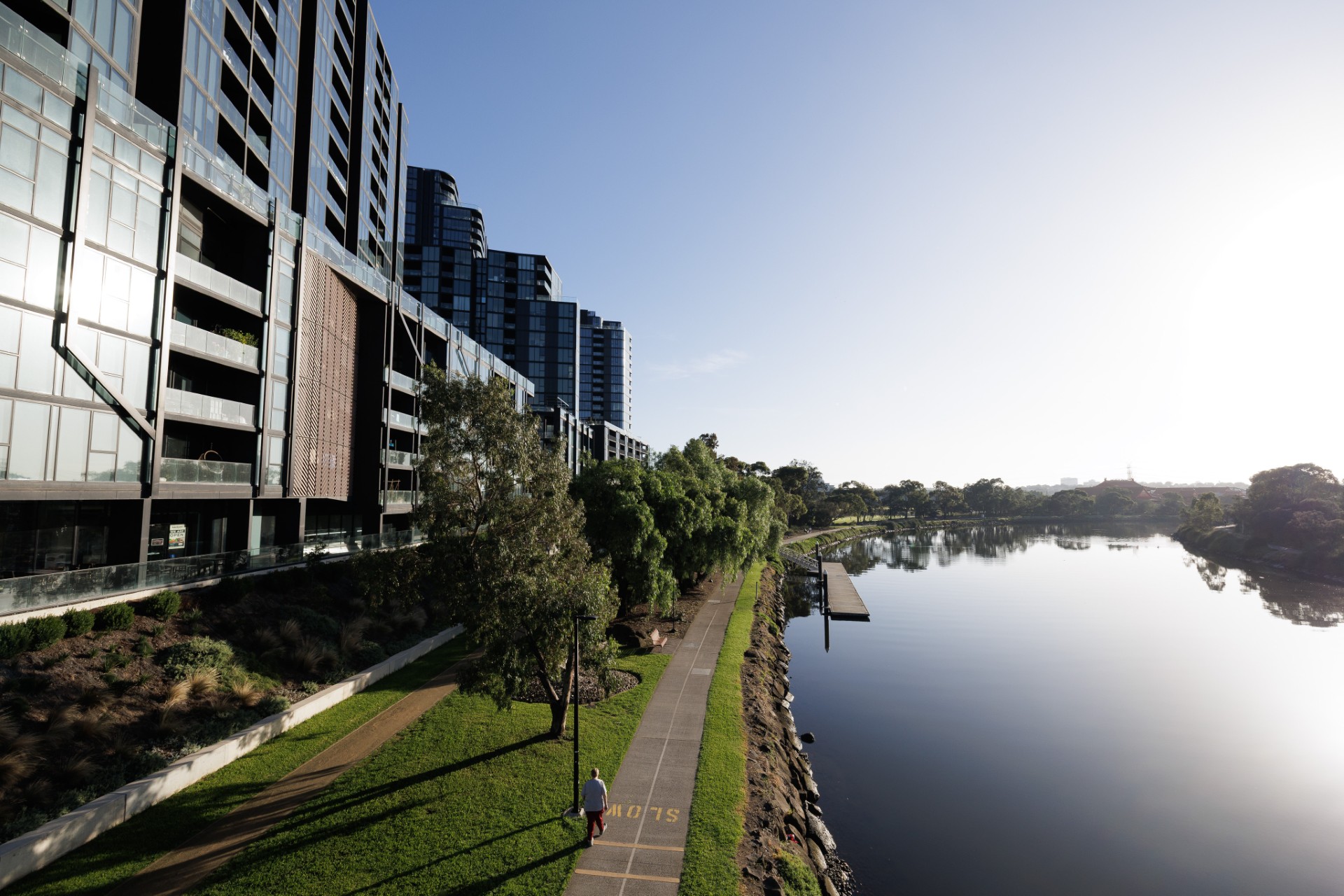
Franco Cozzo Link
BikeWest are working hard with Maribyrnong Council to join the Hopetoun Bridge with central Footscray. We have been led to believe there has been progress on the section between Whitehall St and the river.
Westlink
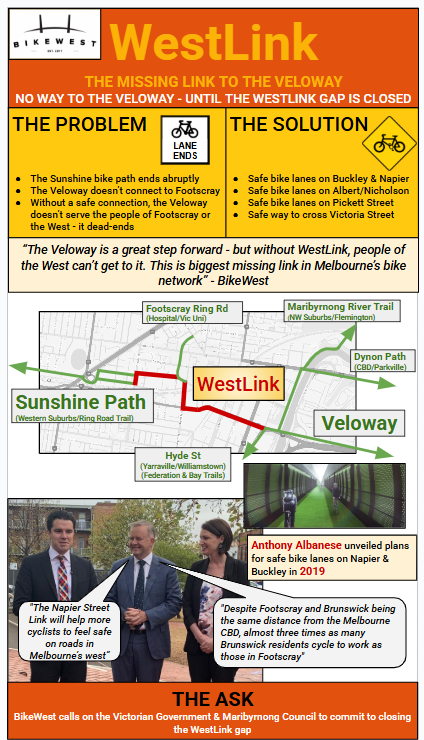
BikeWest is continuing our campaign to lever off the opening of the Dixon Veloway and highlight the gap to the shared user path (SUP) on Cross St beside West Footscray Station. There is a 2km black hole between the Veloway and West Footscray Station and we have drawn up plans that utilise much of the designs the ALP took to the 2019 federal election. We are working with Maribyrnong Council and this will be part of the state election campaign. We have also met with the Assistant Treasurer Daniel Mulino as this is part of his electorate to discuss the possibility of federal funding.
Wyndham Council
Active Transport Strategy
Wyndham Council adopted the Active Transport Strategy 2026-2035. They have a long way to go as by their own admission only 0.2% of trips to work are made by bicycle. Unfortunately it's pretty dire for cycling as Wyndham Council state walking is the cornerstone of active travel and hence the focus is almost entirely upon footpaths despite lots of pretty pictures of people on bikes. Bikes are still pretty much seen only for recreation and the focus for bike in the strategy is on "education and promotion programs" which have a very long history of not working. Overall it's essentially a Walking Strategy with a few pictures of bikes. This strategy is a massive disappointment and given it coincides with the Decade of Sustainable Transport it is all the more disappointing. A missed opportunity and we can state with certainty the 0.2% of trips to work by bike won't change unless the fuel crisis really kicks off now the Chinese have used up their fuel reserve so we don't rule out huge increases in fuel prices.

Research, Local and International News
Bicycling in an autonomous vehicle future
This research explores how bicycles and autonomous vehicles (AVs) interact and coexist. The paper assesses more AVs may affect factors known to promote cycling, including roadway safety, bikeway infrastructure and roadway design, mixed land use, integration with public transport, and car-restraint policies. AVs MAY improve cyclist safety by reducing human driving errors and adhering more consistently to traffic regulations. However, many unresolved challenges remain, such as communication between cyclists and AVs, curbside management, or the possibility of AV-induced increased vehicle miles traveled (VMT) and suburban sprawl. Impacts of AVs will depend on government policies and planning decisions. Cities seeking to promote more sustainable transport should integrate AVs in a way that supports walking, cycling, and public transport. Continued investment in proven bicycle-supportive policies and infrastructure will remain essential.
https://www.sciencedirect.com/science/article/pii/S3051360X26000107
Evaluating the influence of flashing speed limit signs in school zones on driver behavior
Reduced-speed school zones can provide a safer and more walkable environment for children and young adolescents. However, speed compliance remains an issue despite the inclusion of mitigation techniques such as signage and pavement markings. Traffic Control Devices such as School Speed Limit When Flashing Signs can help reduce this risk, but there is still an opportunity for improvement. Yielding rates revealed that drivers stopped more frequently when the SLSB was on, and there was one child and one adult queued at the crosswalk. These findings aligned with the speed assessment, where the largest reduction was observed in this variable combination, resulting in statistically significant speed reductions of 2.87 to 2.91 mph. Additionally, speed after passing the SLSB revealed that the optimal location for this traffic control device relative to the crosswalk may differ based on roadway context. Higher-speed roads may require a larger distance to have adequate space to slow down, while lower-speed roadways may require a closer distance to increase driver attentiveness.
https://www.sciencedirect.com/science/article/abs/pii/S0022437526001301
Impact of cycle lanes and public bike parking on bicycle commuting: How to achieve France’s cycling mode share target?
Despite its well-documented benefits, cycling accounts for only 5% of home-to-work journeys of less than 5 km in France. Towards sustainable transportation, the French government is embarking on a national target of 12% modal share by 2030. However, the limited knowledge of the quantitative impact of additional bicycle infrastructure on bicycle commuting and heterogeneity in municipalities makes it difficult to achieve an equitable nationwide distribution of bicycle infrastructure. To fill these gaps, this study investigates the impact of additional cycle lanes and public parking spaces on bicycle commuting in mainland France. Census data with 6.7 million observations are enriched with spatial information to build four correlated random error Logit models. The results show that a one-unit increase in the rate of cycle lanes increases bicycle commuting by approximately 21% and 15% in the municipality of residence and work, respectively. A one-unit increase in public parking space increases bicycle commuting by 5% and 1% in the municipality of residence and work, respectively. From a policy perspective, there are several conclusions: (1) there is potential for cycling in high-density areas given additional cycle lanes and parking spaces in the municipality of work; (2) medium and low-density areas would require more infrastructure in the municipality of residence; (3) reaching the national target would require jointly increasing the supply of cycle lanes and parking spaces by twofold. If treated as mutually exclusive, the target is achievable by increasing the length of the cycle lane 2.3 times or the parking spaces 17 times. These findings provide a strong policy basis for funding and allocating additional national bicycle infrastructure according to population density and cycling patterns.
https://www.sciencedirect.com/science/article/pii/S0967070X26001757
New Recommendations from the Safe System Consortium
The Consortium recommendations stress key themes:
- Break down institutional silos. To reach the next level of road safety, we need active collaboration among vehicle designers, road engineers, and traffic laws and enforcement. By aligning strengths and adjusting for gaps in prevention, a coordinated plan incorporating vehicles, roads, and road user laws can proactively address the most serious traffic risks.
- Provide tools to guide design decisions and maximize return on investment. Cross-sector collaborations are essential for progress but are a big change from conventional practice. Systemwide collaboration at the federal, state, and local agency levels requires focused research, new models, and guidance.
- Leverage flexible safety funding for cost-effective safety solutions. The Safe System approach allows flexibility in local investment by guiding road improvements with a set of design and program principles rather than prescribing specific countermeasures.
Active Transportation Case Studies
Using examples from Fresno County and Imperial County, California, these case studies explore how jurisdictions fund infrastructure through voter-approved taxes and levies, grant programs, and planning processes such as general plans and Vision Zero action plans. They emphasize strategies where health departments are often most involved, including grant applications, implementation, and community engagement